
The Art & Heart of EMDR
Beyond the Basics Reboot
EMDR & Ketamine Integration
An Introduction
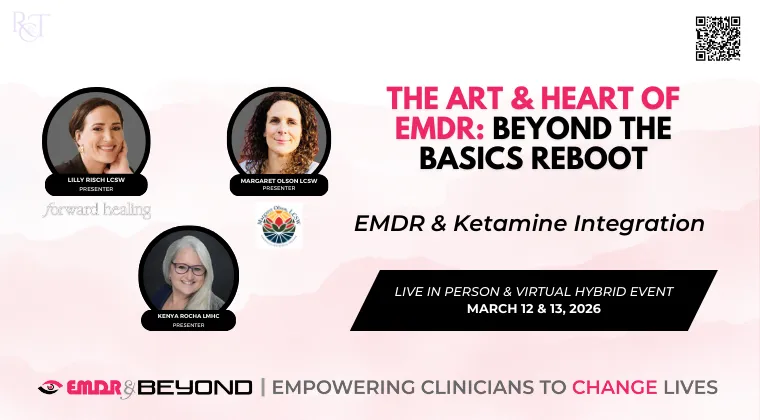
Explore the clinical integration of EMDR and ketamine-assisted psychotherapy with clarity, rigor, and ethical precision.
This 14-hour continuing education program is designed for licensed mental-health clinicians who have completed EMDR Basic Training and are ready to deepen their understanding of EMDR while responsibly exploring its integration with ketamine-assisted psychotherapy. Through a comprehensive “reboot” of EMDR fundamentals and a structured introduction to ketamine-informed care, this training equips clinicians to navigate an emerging treatment frontier with confidence and caution.
Participants will revisit EMDR’s theoretical foundations, 8 Phases, 3 Stages, and Roy Kiessling’s Processing Continuum, while strengthening belief-focused interventions, affect regulation, and resourcing strategies that support complex trauma work. The course also examines cultural and systemic considerations when working with at-risk and marginalized populations, emphasizing culturally responsive and ethically grounded care.
A core focus of the training is the neurobiological and clinical intersection of EMDR and ketamine-assisted psychotherapy. Clinicians will learn how ketamine may impact trauma processing, when integration may be clinically appropriate, and—critically—when it is not. The program addresses risks, contraindications, safety protocols, ethical guidelines, and collaborative care considerations when working alongside medical providers.
Through lecture, live demonstration, applied practice, and case-based discussion, participants will learn to design thoughtful, safe session structures that honor both EMDR fidelity and client safety. The course concludes with a review of current research, emerging best practices, and legal and ethical frameworks shaping this evolving area of clinical work.
Clinicians will leave with a clearer conceptual model, sharper clinical judgment, and practical tools for integrating EMDR with ketamine-assisted psychotherapy—where appropriate—while maintaining ethical, cultural, and professional standards.
Course Agenda & Location
Course Objectives
March 12 & 13, 2026
1025 N. 70th St, Wauwatosa, WI 53213
(Milwaukee Area)
Or Live Virtual Option
9am CST - 5pm CST
Day 1
8:30am - Registration & Networking
9:00am - Welcome & Overview
10:am Practice
11:00 Break
11:15 Lecture
12:00 Lunch
1:00 Lecture & Practice
2:00 Break
2:15 Lecture & Practice
4:00 Lecture & Activity
4:45 Questions & Wrap Up
Day 2
8:30am - Registration & Networking
9:00am - Welcome & Overview
10:am Practice
11:00 Break
11:15 Lecture
12:00 Lunch
1:00 Lecture & Practice
2:00 Break
2:15 Lecture & Practice
4:00 Lecture & Activity
4:45 Questions & Wrap Up
Describe the neurobiological foundations of EMDR therapy.
Demonstrate the application of EMDR’s 8 Phases and 3 Stages.
Identify strategies to assess belief system congruence and apply cognitive interweaves.
Apply the EMDR Processing Continuum (EMD, EMDr, EMDR).
Implement advanced affect regulation and somatic resourcing techniques.
Incorporate cultural and systemic considerations.
Identify potential benefits and clinical applications of ketamine-assisted EMDR therapy.
Evaluate risks and contraindications of ketamine use in psychotherapy.
Explore the safety profile of Ketamine and its therapeutic effects.
Critically review current research, legal frameworks, and ethical standards.
Cost
479.99 Full Price
EARLY BIRD Coupon Code KREBOOT26
EARLY Bird Ends Feb 25, 2026
Please choose your preferred attendance
Your Instructors